You have found the perfect plot, sketched out the extension, or finally got the go-ahead from your client to develop a site. Then the planning officer asks for something you were not expecting: a tree survey. If you have never been asked for one before, it can feel like an unwelcome hurdle. In reality, it is one of the most useful documents in your whole application, and it is usually far less daunting than it sounds.
This guide explains what a tree survey for a planning application actually is, when councils ask for one, what the report contains and how to avoid the delays that catch people out. Whether you are a homeowner planning a single-storey extension or a developer with a multi-unit scheme, you will come away knowing exactly what to expect.
Why Councils Ask for a Tree Survey for Planning
Trees are a material consideration in planning. That simply means the council has to weigh them up when it decides your application. Mature trees add character, wildlife value and shade to a neighbourhood, and once they are lost they take decades to replace. Councils would rather know about them at the start than discover a problem halfway through construction.
A tree survey for planning gives the case officer the evidence they need. It shows which trees are on or beside your site, how healthy they are, which are worth keeping and how your proposed building work will affect them. Without it, many councils will not even validate (accept) your application, which means the clock never starts ticking.
The good news is that a well-prepared survey works in your favour. It shows you have taken the trees seriously and designed around them, and that builds confidence with the planning team.
What Is a BS5837 Tree Survey?
When people talk about a tree survey in a planning context, they almost always mean a BS5837 tree survey. BS 5837 is the British Standard called “Trees in relation to design, demolition and construction”. It sets out how trees should be assessed and protected when development is planned near them, and councils across the UK use it as the benchmark.
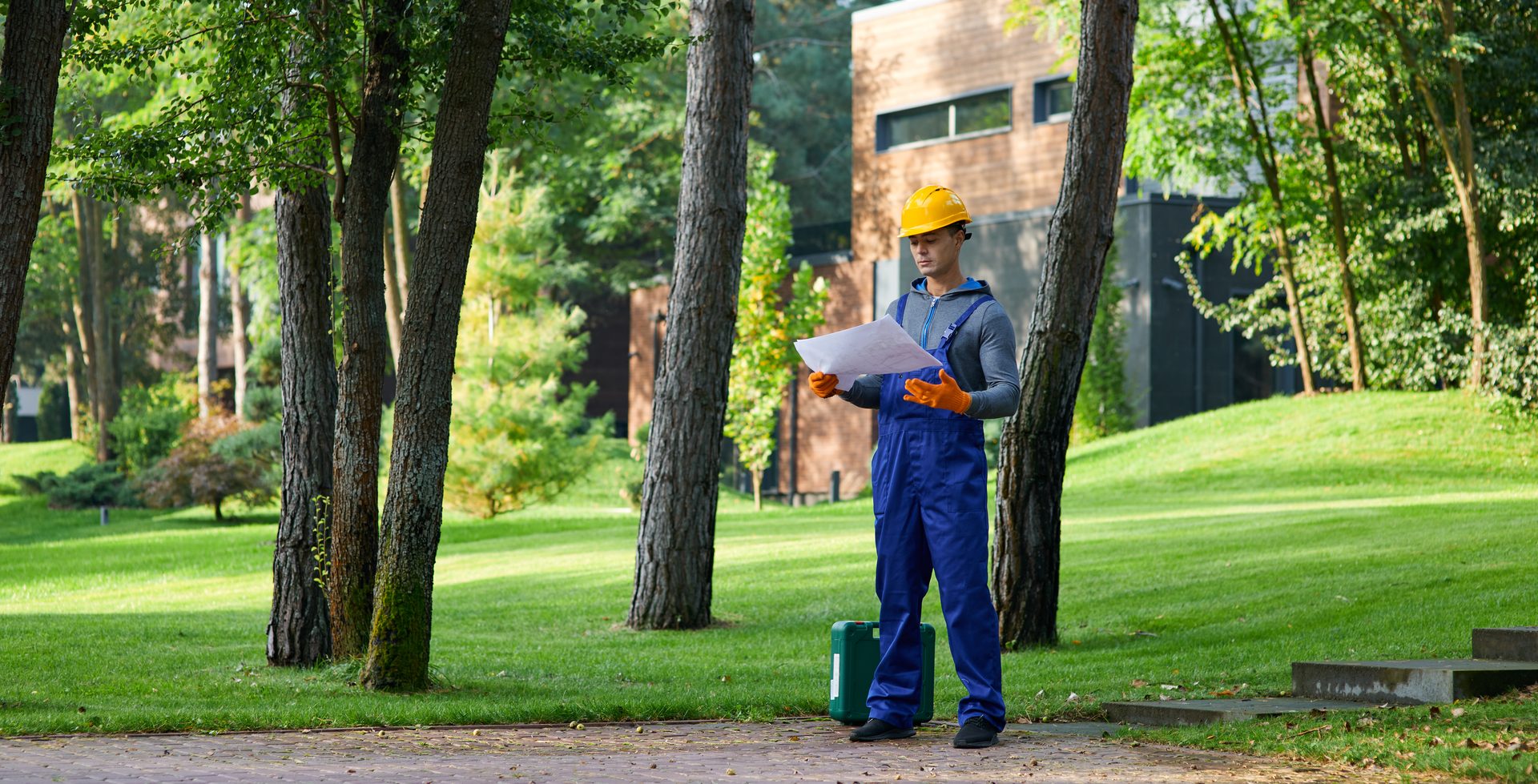
A BS5837 survey is carried out by a qualified arboriculturist. They visit the site, identify every significant tree that could be affected, measure it and record its condition. Every tree gets a unique number, and the findings are drawn up on a plan that sits alongside your architect’s drawings.
It is quite different from a general tree health check or a safety inspection. A safety inspection asks “is this tree likely to fall?”. A BS5837 survey asks “how should this tree influence the design of the scheme?”. If you are curious about the first type, our guide to tree surveys and reports for home extensions shows how the two fit together on smaller projects.
When Do You Need a Tree Survey for Planning Permission?
There is no single national rule that applies to every project. Each council publishes its own “local validation list” setting out what it needs with an application, and a tree survey is nearly always on it. As a general guide, you are likely to need one if:
- There are trees on your site, including trees that are not particularly large.
- There are trees on neighbouring land close enough that their roots or branches could be affected by your work.
- Trees are protected by a Tree Preservation Order, or your property sits in a conservation area.
- Your proposal involves new buildings, extensions, driveways, changes of level or new services such as drainage.
- You are demolishing an existing building close to trees.
Even where a tree survey is not strictly required, it can still save you money. Discovering that a neighbour’s oak has a large root zone running right through your planned foundations is much cheaper to learn before you submit drawings than after.
If your site has protected trees, it is also worth reading our explanation of Tree Preservation Orders and what they mean for your building project, because working on a protected tree without consent can lead to serious penalties.
Understanding Tree Categories: A, B, C and U
One of the first things you will see in the report is that every tree has been given a category. This is the system BS5837 uses to decide which trees should shape your design and which can be removed without much concern.
- Category A (high quality): Trees of high value, with an estimated remaining life of at least 40 years. These are the ones you should try hardest to keep.
- Category B (moderate quality): Trees of moderate value with at least 20 years of life remaining. They should be retained where practical.
- Category C (low quality): Young trees, or trees with at least 10 years of life left. They should not stand in the way of a good scheme.
- Category U (unsuitable): Trees in such poor condition that they cannot realistically be kept for more than 10 years. They are normally recommended for removal whatever the development.
The categories are what planning officers look at first. A scheme that keeps its A and B category trees and only removes lower-value ones will usually be received far more warmly than one that needs to fell a veteran oak. If you want to go deeper on this, we cover it step by step in our guide to tree categories.
What Is Included in a Tree Survey for a Planning Application?
A complete tree survey for planning application purposes is usually made up of several documents. Not every project needs all of them, so it is worth checking what your council asks for.
The tree survey schedule and plan. This is the foundation. It lists each tree, its species, height, trunk diameter, branch spread, condition and category. The accompanying plan shows where each tree stands and marks its Root Protection Area.
Root Protection Area (RPA). The RPA is the area around a tree that should be kept free from construction to protect its roots. For a single-stemmed tree it is worked out from the trunk diameter, and it is drawn as a circle on the plan. Your architect then designs around it. Where building within the RPA cannot be avoided, special construction methods may be possible, but you need to explain and justify them.
Arboricultural Impact Assessment (AIA). Once the architect has a layout, the arboriculturist reviews it against the survey. The impact assessment explains which trees will be removed, which will be affected by the work and how any harm will be reduced.
Tree Protection Plan and Arboricultural Method Statement. These show how retained trees will be protected while building takes place. They cover fencing, ground protection, where machinery and materials can go and how work close to roots will be supervised. Some councils ask for these at application stage, and others make them a condition of approval.
Trees on Neighbouring Land and Protected Trees
A common surprise is that the survey is not limited to your own boundary. If a neighbour’s tree is close enough that its roots or canopy will be affected by your plans, it must be included. Councils take this seriously because the neighbour’s tree is just as valuable to the street as yours.
The same applies to trees covered by a Tree Preservation Order and trees in a conservation area. In a conservation area you normally need to give the council six weeks’ written notice before cutting down or carrying out major work on a tree. For a protected tree, you need formal consent. Getting this wrong can lead to heavy fines, so check early. If you are unsure, our team can confirm the position for you at the outset.
How Long Does It Take and When Should You Book?
The site visit for a tree survey for planning application is usually quick, often a matter of hours for a typical residential plot, though larger sites take longer. The report then takes time to prepare, because every tree has to be measured, categorised and drawn up on the plan.
The most common mistake is booking the survey late. Ideally you want the tree survey carried out before the architect finalises the layout, because the findings should shape the design. If you commission it after the drawings are complete, you may find the layout has to be changed. Our article on pre-planning tree surveys explains how doing it first can maximise what you are able to build.
Season matters less than people think. Trees can be surveyed all year round. Winter has the advantage that bare branches make the structure easier to see, but evergreens and summer visits are perfectly acceptable to most councils.
Common Mistakes to Avoid
After many years of helping people through the process, the same problems come up again and again.
- Leaving it until after the design is finished. This is the biggest cause of wasted money and redrawn plans.
- Ignoring neighbouring trees. They count, even if they are not on your land.
- Building a driveway or laying services through root zones. It is easy to forget that drainage, cabling and paving can harm roots just as much as foundations.
- Submitting a generic or out-of-date report. Councils can reject surveys that do not follow BS5837, or that were prepared for a different layout.
- Removing a tree before applying. Doing so can undermine your case, and if the tree was protected, it could be a criminal offence.
Choosing Who Carries Out Your Survey
Your tree survey for planning application needs to be completed by someone with proper arboricultural qualifications and experience of the planning system. Look for a consultant who works to BS5837, understands what your local council expects and is happy to talk you through the findings in plain English.
It also helps to choose a consultant rather than a tree surgery firm. Consultants give independent advice about the trees and the planning process, whereas a tree surgeon’s main role is carrying out the physical work. If you are not sure which you need, our comparison of an arboricultural consultant and a tree surgeon will help you decide.
A good consultant will also offer practical advice, not just a report. They will tell you which trees are worth designing around, where you have flexibility and how to present your case to the council. That guidance can make the difference between a smooth approval and months of back and forth.
Your Tree Survey for Planning Application With Canopy Consultancy
At Canopy Consultancy we prepare BS5837 tree surveys, impact assessments and protection plans for homeowners, architects and developers across Surrey and the surrounding area. We keep things clear and jargon-free, and we work with your design team from the start so the trees help your scheme rather than hold it back. You can read more about our planning application support on our website.
If you have been asked for a tree survey, or you are not sure whether you need one, we would be happy to talk it through. Get in touch with our team for a friendly chat about your project, or head back to the Canopy Consultancy home page to see everything we offer.
Share This Story, Choose Your Platform!
About the Author: Canopy Consultancy